Potassium Chloride for Metal Treatment: Applications, Benefits & Industrial Uses
Potassium Chloride for Metal Treatment: Applications, Benefits & Industrial Uses
Introduction
Potassium Chloride (KCl) is an inorganic salt widely used across several industrial sectors because of its excellent solubility, chemical stability, and reliable performance. While potassium chloride is commonly associated with fertilizers, food processing, and chemical manufacturing, it also has important applications in metal treatment and metal finishing processes.
In metal treatment, potassium chloride can be used as a source of chloride ions and potassium ions in specially formulated processing baths. It is particularly relevant to electroplating, surface treatment, metal finishing, and certain corrosion-control processes, depending on the formulation and type of metal being treated.
What Is Potassium Chloride?
Potassium Chloride is a white or crystalline inorganic compound with the chemical formula KCl. It is highly soluble in water and provides potassium and chloride ions when dissolved.
Its key characteristics include:
-
Chemical formula: KCl
-
Appearance: White crystalline powder or granules
-
High water solubility
-
Good chemical stability
-
Consistent ionic composition
-
Suitable for aqueous industrial formulations
The required grade and purity of potassium chloride depend on the specific metal treatment application.
Role of Potassium Chloride in Metal Treatment
Potassium chloride is particularly important in electrochemical and metal finishing applications. In an appropriate treatment bath, chloride ions can contribute to the conductivity and chemical characteristics of the solution.
Depending on the process formulation, KCl can help:
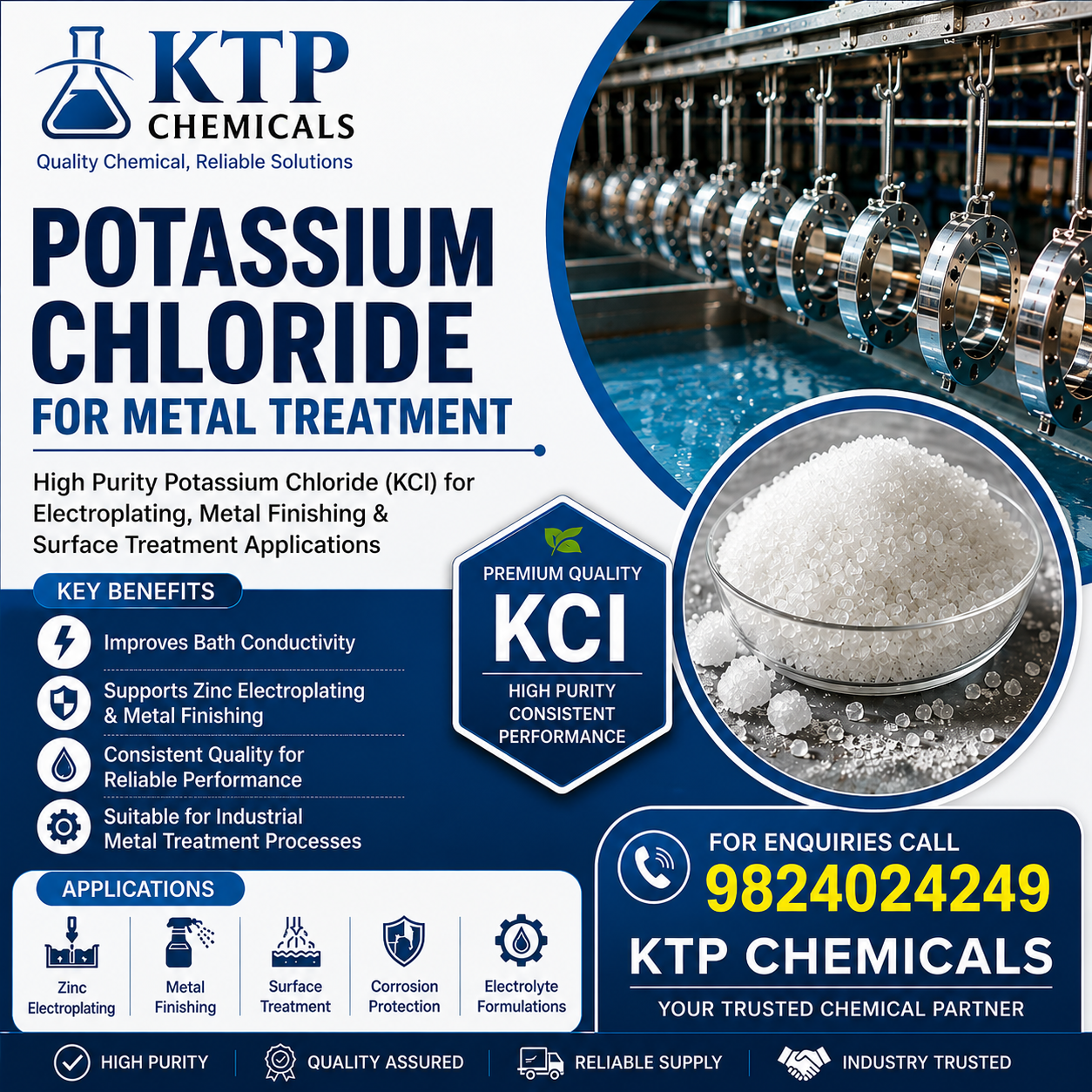
1. Improve Bath Conductivity
Potassium chloride dissociates in water into potassium and chloride ions. These ions contribute to the electrical conductivity of aqueous solutions, which can be important in electrochemical metal treatment and plating processes.
2. Support Electroplating Processes
Chloride-containing formulations are used in various electroplating systems. Potassium chloride may be incorporated into certain plating baths as part of the overall electrolyte formulation.
Its use depends on the metal being deposited, the plating chemistry, operating conditions, and desired surface properties.
3. Maintain Consistent Processing Conditions
In industrial metal treatment, maintaining a controlled chemical environment is important for obtaining consistent results. Potassium chloride can be used as a controlled source of chloride ions where specified by the process formulation.
4. Support Metal Surface Finishing
Metal finishing operations often require carefully balanced chemical baths. Potassium chloride may form part of these formulations, particularly where chloride chemistry is required for process performance.
Potassium Chloride in Zinc Electroplating
One of the important industrial areas associated with potassium chloride is chloride-based zinc electroplating.
In chloride zinc plating systems, potassium chloride can be used as a supporting electrolyte. The plating bath is carefully formulated with zinc salts, chloride salts, additives, brighteners, and other components.
A properly controlled zinc plating process can provide:
-
Improved surface appearance
-
Uniform zinc deposition
-
Corrosion protection
-
Good coating adhesion
-
Consistent plating performance
The exact formulation varies according to the plating equipment, substrate, bath chemistry, and desired coating specifications.
Advantages of Potassium Chloride for Industrial Metal Treatment
Potassium chloride offers several characteristics that make it useful in selected industrial metal treatment applications.
High Solubility
KCl dissolves readily in water, making it convenient for preparing aqueous processing solutions.
Consistent Chemical Composition
Industrial processes require predictable raw materials. Potassium chloride provides a consistent source of potassium and chloride ions.
Good Electrolytic Properties
Its ionic nature makes it useful in applications where electrolyte conductivity is important.
Easy Handling
Potassium chloride is generally supplied as a crystalline solid and can be stored and handled using standard industrial practices appropriate for the selected grade.
Versatile Industrial Application
Depending on formulation requirements, KCl can be used in different chemical and electrochemical processes associated with metal finishing.
Applications of Potassium Chloride in Metal Industries
Potassium chloride can be relevant to several areas of metal processing, including:
-
Chloride zinc electroplating
-
Metal finishing formulations
-
Electrochemical processing
-
Surface treatment baths
-
Industrial electrolyte formulations
-
Corrosion-protection processes
-
Supporting electrolyte systems
The suitability of KCl should always be evaluated against the specific process chemistry and technical requirements.
Importance of Potassium Chloride Quality
For industrial metal treatment, the quality of the raw material can influence process consistency. Important parameters may include:
-
KCl purity
-
Moisture content
-
Insoluble matter
-
Chloride concentration
-
Appearance
-
Trace metal impurities
-
Particle size
-
Packaging and storage conditions
For demanding applications, buyers should request a Certificate of Analysis (COA) and Technical Data Sheet (TDS) from the supplier before purchasing.
How to Select Potassium Chloride for Metal Treatment
When sourcing potassium chloride for industrial use, consider:
1. Required purity: Select a grade appropriate for the intended treatment process.
2. Process compatibility: Confirm that KCl is compatible with the existing plating or treatment bath.
3. COA availability: Ensure important chemical parameters are documented.
4. Packaging: Choose moisture-resistant packaging suitable for transportation and storage.
5. Supply consistency: Industrial plating operations benefit from consistent quality and reliable supply.
6. Technical support: A knowledgeable chemical supplier can help match the appropriate grade to the application.